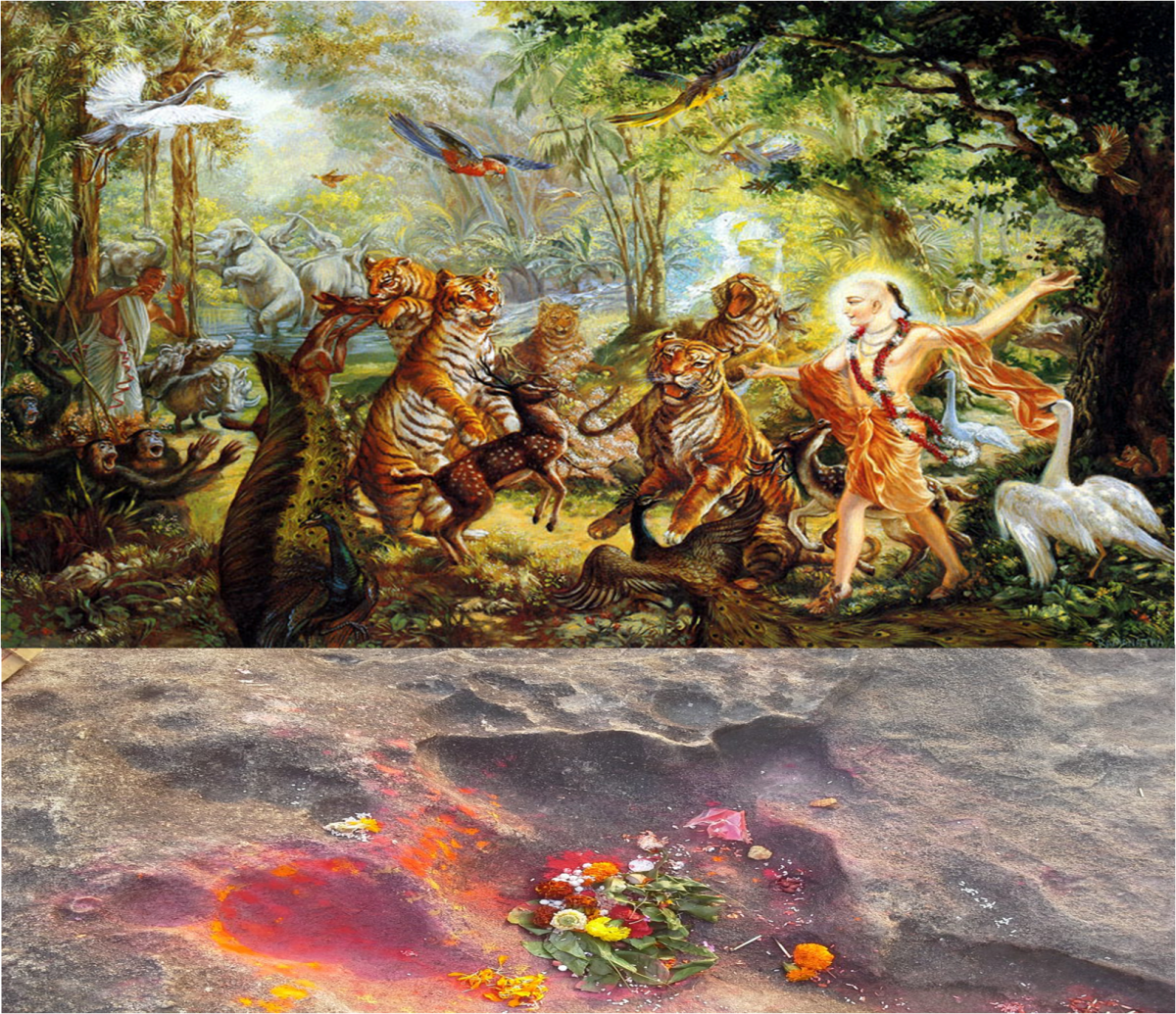
Bhakti and mood of service are inseparable. If someone is in Bhakti it alternatively means that that person has service attitude. It is however necessary to understand the nature of service of the Bhakta as compared to the layman’s idea of service. The two, namely, the devotee’s servitude mood and that of Continue reading “Mood of Service”
Category: General
Radha Kunda Tilaka
Tilaka applied on the body at twelve places is one of the most important and indispensible aspects of Vaishnavism. Especially in the Gaudiya way of living applying tilaka on the body is of paramount importance. It becomes compulsory for a person who has atleast taken Hari Nama Samskaar to wear tilaka on 12 parts of the body. The tilaka Continue reading “Radha Kunda Tilaka”
Bhajana Rasika
Bhajana is for people who are serious in attaining the eternal service of the Lord. Eternal service in the context of our material life represents the consciousness with which we attend to the needs of the material life and the quality of consciousness that is applied for service of the divine couple with the mind. Continue reading “Bhajana Rasika”
Liberation
Jivan-mukta or a person on a liberated platform is seen with different understanding from the standpoint of each of Ashtanga Yoga, Jnana Yoga and Bhakti Yoga. A person who stands liberated even while being functional in the body can only be a devotee, not a person from the Ashtanga or Jnana Yoga marga. Continue reading “Liberation”
Intention is everything in Bhakti
Bhakti is a process of the mind. Devotion of the mind or “Manasa Seva” is the highest form of service that can be offered to the Lord. Mind is the seat of all activities both physical and mental. Continue reading “Intention is everything in Bhakti”
Trinad api sunicena misnomer
Trinad api sunicena , Taror api sahishnunaam says Sriman Mahaprabhu. This is the start of the 3rd shloka of His creation the Shikshashtakam. To be humble like the blade of grass and to be tolerant like a tree , is the hall mark of Vaishnava says He. We see that almost all Vaishnavas of the popular movements claiming to belong to the cult of Sriman Mahaprabhu display such characteristics of being very humble and also as being tolerant. There is no doubt about this. In a way almost all followers wearing the holy Tulsi “kanthi mala” or neck-band and the Gopi Candana tilaka easily follow this dictum and easily display these characteristics. Yet the larger question remains ; are the qualities of an ideal Vaishnava really evident through such behaviour? The answer is a simple “No”. Continue reading “Trinad api sunicena misnomer”
Moods of Mahaprabhu
 Gaudiya Vaishnavism is a parampara based on the various moods of Sri Nandanandana based on the “original mood” as transmitted into the system by Sriman Mahaprabhu. The intention of the statement can be elaborated by a small example. For a person who “attains His swaroop” or original nature makes the slightest distinction when he is dealing with “rasa” or devotional mellow. For example for a person who appreciates
Spiritual Transparency
This is not much talked about topic in spiritual circles. But this is the most relevant topic concerning spiritual growth in one’s life. There are a lot of Spiritual establishments that handle thousands and lakhs of devotees. However such Spiritual establishments will not have a deep impact on anyone’s life. One may only get introduced to spiritual concepts in such places and one may experience some relief from material pain; nothing more than this. The concept of spiritual transparency is experienced only in a “free-share” environment where there are no self or society created walls amongst individuals seeking the same spiritual goal. Continue reading “Spiritual Transparency”
Dharana- The Heart of Bhajana
As I spoke to Srila Gurudeva yesterday , interestingly Gurudeva spoke about a concept rarely discussed. This again cemented my basic understanding that without the presence of a Siddha Guru in one’s life ; it is not possible to attain the ultimate goal “Krishna Seva Prapti”. Continue reading “Dharana- The Heart of Bhajana”
Ornaments of a Vaishnava
The material world is actually a great place. It is managed by Sri Maya devi (Both Jeeva Maya and Yoga maya). I say this because if there were no material world then there is no scope of Vaishnavas being generated from here and then being sent to the spiritual world. There was no scope of a “baddha” becoming a “bhakta” and then being promoted to the platform of Nitya Sevak on the transcendental platform. Continue reading “Ornaments of a Vaishnava”
 Charan Pahari